Best Cat Trees for Maine Coons (Sturdy Picks That Won’t Tip)
If you’ve ever watched your Maine Coon launch himself off a wobbly cat tree and shake the whole room, you know the truth most pet store labels won’t tell you: the average cat tree was never built for a cat like ours. Standard trees are designed around an 8–10 pound house cat. My boys push 18 and 20 pounds of pure muscle, and over the years I’ve lost count of how many flimsy towers ended up donated, in pieces, or tipping over mid-zoomies.
The best cat trees for Maine Coons aren’t just bigger versions of regular cat trees. They need different engineering: heavy bases, extra-thick posts, perches a Maine Coon can actually stretch out on, and a way to anchor them so they can’t tip. I learned most of what I know by buying the wrong ones first, and by listening to owner communities where people are brutally honest about what survives a 20-pound cat. Here’s what actually matters, plus the sturdy picks real Maine Coon owners keep recommending.
Why Regular Cat Trees Fail Maine Coons
It comes down to physics. A Maine Coon doesn’t just sit on a tree — he leaps onto it from across the room, sometimes landing on the very top perch at full speed. Owners in large-breed groups report cats weighing 15 to 25 pounds, and it’s that jumping, climbing, full-body weight hitting a small platform that destroys cheap trees.
The failure points are always the same, according to owners on Reddit and in Maine Coon owner groups:
- Narrow bases. A 60-inch tower with a base barely bigger than a placemat will wobble — and eventually tip — when a 20-pound cat hits the top shelf.
- Thin posts. Standard trees use skinny particle-board columns that crack under repeated heavy landings; thick, solid-wood or extra-thick wrapped posts last years longer.
- Tiny perches. A Maine Coon can’t curl onto a 14-inch round platform without half his body hanging off. He’ll either ignore the tree or use it uncomfortably.
- Wobbly construction. Particle board plus friction-fit hardware loosens over time — owners with older trees check the screws periodically.
One commenter in a big-cat furniture group described replacing her old unstable tree after it tipped over when her cats jumped on it — durability became her number-one criterion for the replacement.
If you’re still figuring out just how big your cat is going to get, my post on Maine Coon size comparison will give you a reality check on the weights these cats reach.
What to Look For in the Best Cat Trees for Maine Coons
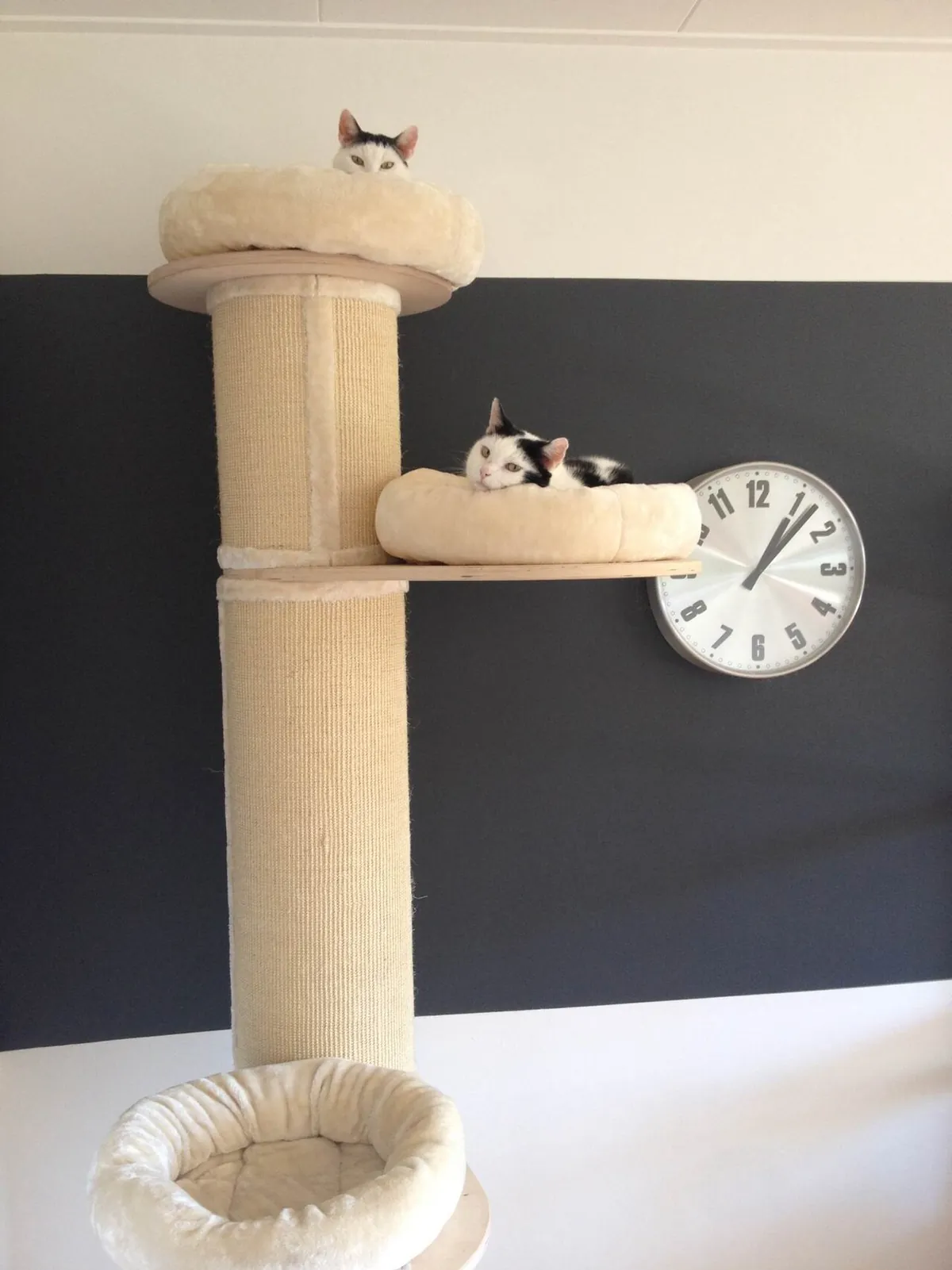
Before we get to specific picks, here’s the checklist I use. If a tree doesn’t meet most of these, it goes back in the search results.
A wide, heavy base. Look for a base at least 24 inches across — bigger is better. Trees made for large breeds often weigh 40–70+ pounds on their own, which is a good sign. Light in the box means light when your cat lands on it.
Thick posts, ideally 4+ inches in diameter. Thick posts take the weight without snapping and give your cat a real scratching surface. Many owners look for solid wood construction rather than hollow or particle-board columns.
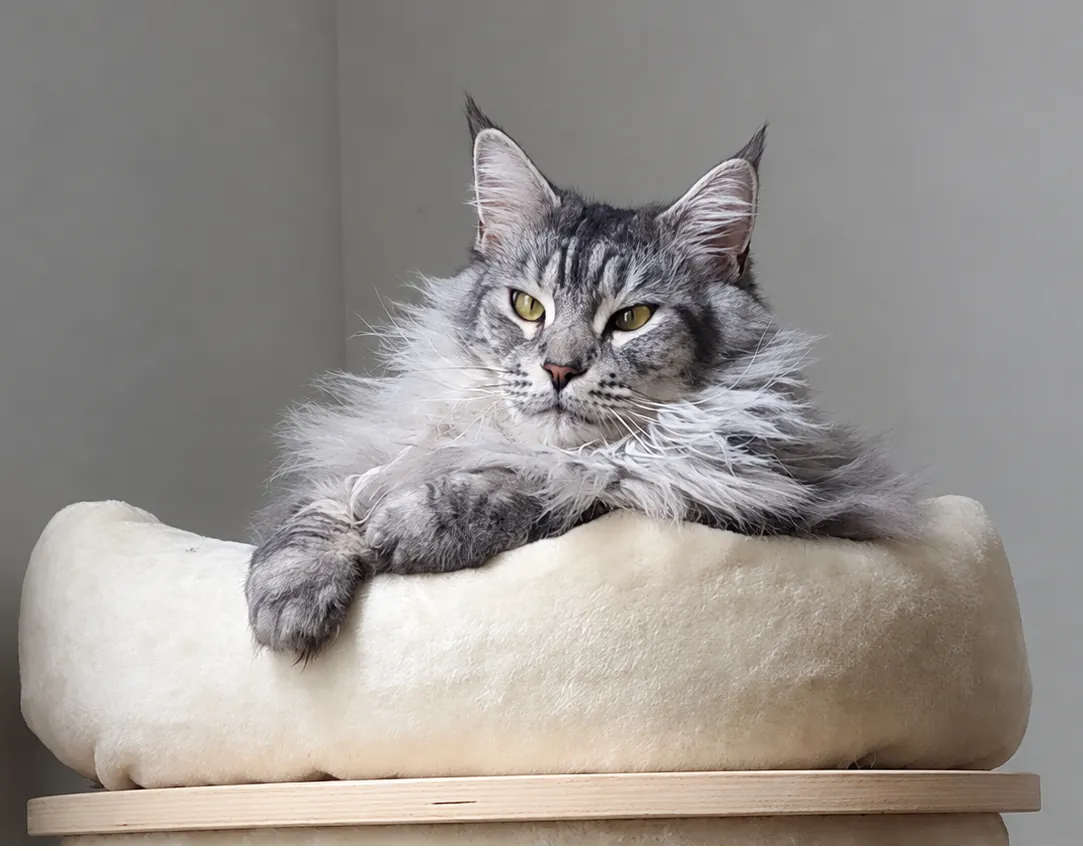
Big perches and platforms. A top perch of at least 20 inches across is the minimum for a lounging Maine Coon. Large rectangular platforms beat small round ones — owners consistently report that their Maine Coons prefer big flat rigid surfaces over small curved cradles.
An anti-tip anchor. Wall straps or brackets are the cheapest insurance for any tall tree. Tons of owners in big-cat groups anchor to the wall — several say it saved them from a tip-over. If you can’t drill, a floor-to-ceiling tension design is the alternative.
Replaceable or durable scratching surfaces. Better-quality glue-down sisal lasts much longer than cheap wrap, and some premium makers sell replacement posts — a big deal when a Maine Coon’s claws shred a cheap post in months.
Condo openings sized for big cats. Those cute little cubby holes on standard trees? Most Maine Coons can’t fit through them. Check that openings are generous — otherwise it’s wasted space.
A good tree also protects your furniture, but if your cat is shredding things the tree doesn’t cover, my guide on Maine Coon behavior problems and how to stop them covers redirecting destructive habits.
The Sturdy Picks: What Real Owners Recommend
These aren’t ranked by affiliate payout. They’re organized by type, and the names here come up again and again in Reddit threads, Facebook groups, and owner reviews — multiple real owners behind each one. If you’re shopping for the best cat trees for Maine Coons, this is the shortlist the community keeps landing on.
1. The Solid-Wood Premium Tree (Cat Tree King)
If there’s one name that comes up in every “sturdy cat tree for Maine Coons” conversation, it’s Cat Tree King. Owners on Reddit, in Facebook groups, and in product reviews consistently describe their trees as genuinely sturdy even with big cats on them. The company is a small Belgium-based business with US warehouses, designing for large breeds — thick sisal poles (reportedly around 5 inches), large hammocks, roomy lounges, and genuinely heavy construction.
The catch: premium pricing, often several hundred dollars. Owners who bought them say “lasted 7 years” and “best quality cat tree I have ever seen” — the consensus is you pay once instead of replacing a cheap tree every year.
2. The Made-in-the-USA Wood Tree (Prestige / New Cat Condos)
Reddit threads about Maine Coon cat trees frequently recommend Prestige’s Maine Coon-specific tree — real wood and carpet construction, multiple perches, a big base, handmade in the USA. Owners describe it as heavy-duty and built for large multi-cat households. Owners also name New Cat Condos as a go-to, particularly because they sell replaceable parts — a Maine Coon will destroy the sisal posts long before the wood gives out.
3. The Budget/Mid-Range XXL Tower (Warehouse and Chewy Finds)
Here’s the thing nobody expects: multiple Maine Coon owners in Facebook groups report buying tall, sturdy cat trees at Costco for around $80 and being genuinely happy with the durability. One owner documented her two Maine Coons using a new tree specifically because the old one tipped over.
A cattery owner on Facebook also named Chewy’s Frisco 76-inch XXL as one of the options in her own shopping research — big carpeted multi-level towers with multiple condos and big perches are solid mid-range picks. Stock rotates, so grab the sturdy large-format model when you see it, and use the wall anchor it comes with.
4. The Floor-to-Ceiling Tension Tree
The sleeper pick that comes up a lot in owner communities and rarely in mainstream roundups. Floor-to-ceiling tension trees wedge between the floor and the ceiling, which makes tipping essentially impossible. Owners in big-cat groups name tension-mounted designs as one of the best stability solutions for heavy, active cats — and they’re great for small spaces since there’s no wide base eating up the living room. The trade-off: your ceiling height has to work, and the platforms tend to be smaller than on wide-base towers.
5. The DIY / Custom Solid Wood Tree
This is everywhere in the Maine Coon community: owners building their own. On Instagram, a Maine Coon cattery built a tree from a real tree branch, wooden slabs, and rope-wrapped posts, wall-mounted with brackets. In Facebook groups, owners recommend custom builders like Condos and Trees LLC and Cloud 9 Cat Trees for solid-wood construction with flat, roomy platforms. Others describe DIY builds from 2x4s, thick plywood, steel L brackets, and carpet.
The consistent advice: solid wood with proper mounting outlasts any particle-board tree by years.
Where to Put It
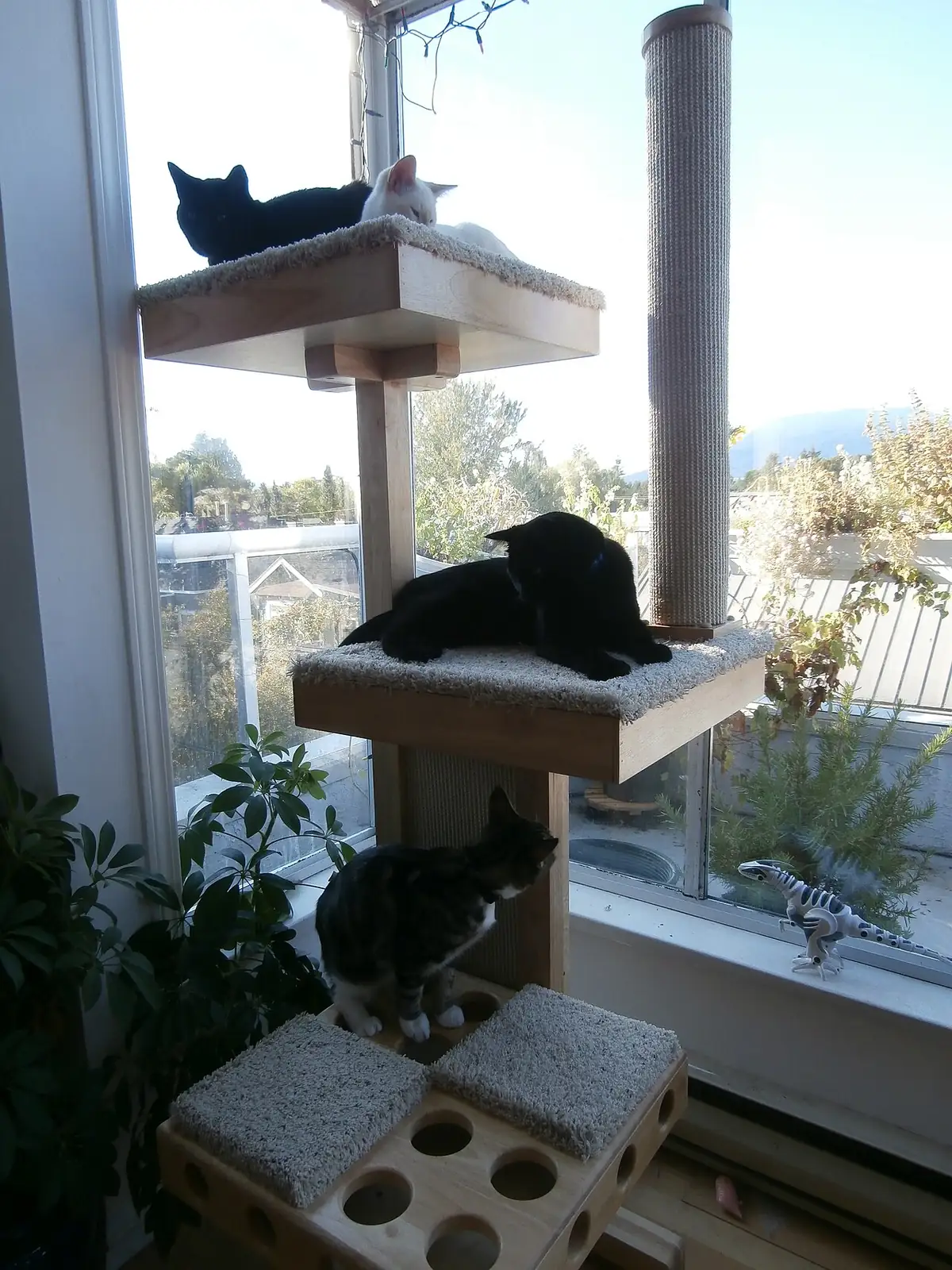
Even the sturdiest tree underperforms if it’s stuck in a dead corner. Here’s what I’ve learned about placement:
In front of a window. The single most-repeated advice in every cat tree discussion. A window perch gives your Maine Coon bird-watching, sunbeams, and hours of entertainment.
In a corner or against a wall. Two extra points of contact for stability, for free. Tall towers especially benefit from corner placement.
Where the family actually is. Maine Coons are famously social — the “gentle giants” that follow you from room to room. A tree in an unused room is decoration, not enrichment. Put it where you spend time.
Away from things it can knock over. A tall tree plus a 20-pound cat launching off it equals a blast radius. Keep it away from lamps and fragile decor.
Safety: The Non-Negotiable Stuff
Anchor tall trees to the wall. Use the included strap or buy a furniture anchor kit. Owners in big-cat groups call this the single most important safety step. It takes ten minutes.
Check the hardware regularly. Screws loosen and wood fatigues. Every few months, tighten everything and inspect posts and platforms for cracks. One owner noted her cat’s tree was “nearly destroyed after four years of use” — a normal lifespan for a heavily used tree.
Mind the weight rating — but don’t trust it blindly. Many ratings assume a cat sitting still. A Maine Coon leaping onto a perch generates far more force than its standing weight, so look for 25+ pounds per perch as a starting point and add a margin.
Senior and overweight cats need different trees. An older Maine Coon with stiff joints shouldn’t be leaping to a 70-inch top perch — lower platforms, ramps, and easy step-up access matter more than height. If your cat is getting older, my senior Maine Coon care guide covers how their needs change, and here’s how to tell if your Maine Coon is overweight.
For vet-reviewed guidance on keeping indoor cats enriched and safe, Cornell Feline Health Center and VCA Hospitals both publish excellent enrichment resources.
My Honest Take
If I could start over with my first Maine Coon, I’d skip the cheap tower and go straight to a heavy, solidly built tree with a wall anchor — or build one myself. Buy heavy, buy wide-based, anchor it to the wall, and don’t trust a per-perch weight rating that assumes your cat sits still. Maine Coons are athletes wrapped in fluff. Their furniture should be built like it.
FAQ
What size cat tree does a Maine Coon need?
At least 60 inches tall with a base 24+ inches wide and perches at least 20 inches across. Maine Coons need platforms they can actually stretch out on — small round perches get ignored. The bigger and heavier the tree, the better it handles a 15–25 pound cat.
Are tall cat trees safe for Maine Coons?
Yes, as long as they’re anchored. A tall tree with a wide base, solid construction, and a wall strap is safe. The danger isn’t the height — it’s an unanchored tower tipping when a heavy cat leaps onto the top.
Why does my Maine Coon ignore the cat tree?
Usually one of three reasons: the perches are too small to stretch out on, the tree wobbles (cats won’t trust an unstable surface), or it’s in a room he doesn’t use. Maine Coons prefer large, flat, rigid platforms over small curved cradles — and a window placement dramatically increases use.
How much should I spend on a cat tree for a Maine Coon?
Budget-friendly heavy-duty options run around $80–150 at warehouse clubs, mid-range XXL towers run $150–250, and premium solid-wood trees can run several hundred dollars. Owners report premium trees lasting many years, while cheap particle-board trees often need replacing within a year or two — so the expensive option is often cheaper per year.
Can two Maine Coons share one cat tree?
Yes, if it’s built for it. Look for multi-level trees with several large platforms so each cat has their own spot, a heavy base, and a high total weight capacity.