Best Toys for Maine Coons: Play Picks Big Enough for a Gentle Giant
The first toy I ever bought for my Maine Coon was a little felt mouse with a bell inside. He picked it up, looked at me, and dropped it like it had personally offended him. Then he went back to attacking the paper grocery bag. That was the day I learned that finding the best toys for Maine Coons is not about buying more toys — it is about buying bigger, tougher toys than you think a cat could possibly need.
A full-grown male Maine Coon can hit 18 to 25 pounds with paws the size of a small dog’s, and he plays at full commitment. Toys made for an 8-pound tabby do not just bore him — they break, they get batted under the fridge in one swipe, and in a mouth that big they can become genuinely unsafe. Owners on social media say the same thing I learned the expensive way: plenty of them shop the dog toy aisle because standard cat toys are too small to register as prey.
Why Regular Cat Toys Don’t Survive a Maine Coon
Three things work against ordinary toys with this breed: size, strength, and jaw power. A standard 3-inch mouse is smaller than one of my boy’s paws, which means he can’t grab it properly and loses interest in about ten seconds. One owner described her big boy getting his paw stuck in a popular ball-track toy — the openings were designed for normal cat paws, and his just didn’t fit.
Then there is strength. Maine Coons bunny-kick with back legs that shred thin plush in an afternoon, and their claws go through cheap fabric like tissue paper. Glued-on eyes, thin ribbons, chewable squeakers — all have an expiration date, and a potential vet visit attached.
That is why sizing matters so much: a toy that is too small is a choking and ingestion risk in a mouth this size. Cornell’s veterinary college advises avoiding toys with small pieces or strand-like parts that can separate and be swallowed — worth remembering every time a cute tiny toy tempts you (vet.cornell.edu).
The Best Toys for Maine Coons, by Play Style
Mine is a chaser who lives for the wand; my friend’s girl is a wrestler who wants something to grab and kick. Watch your cat for a few days and you will know which camp yours falls into.
Wand teasers: the number-one pick for bonding
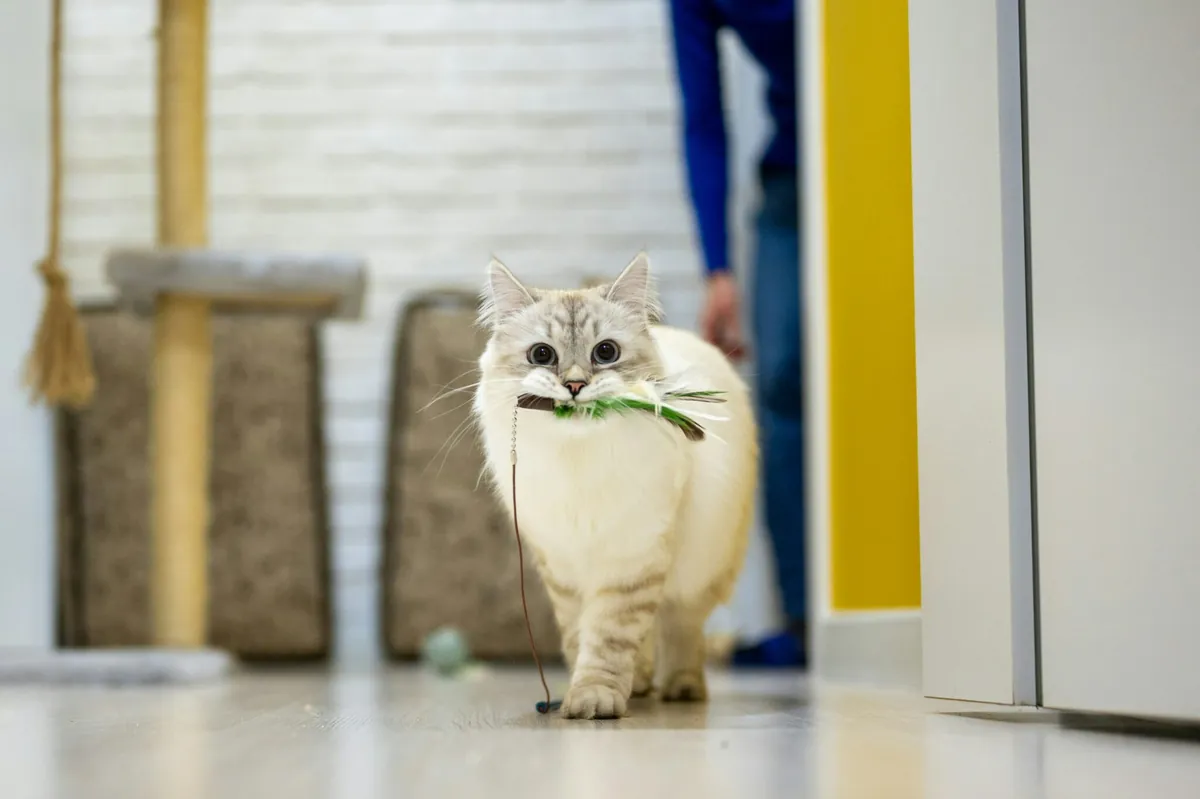
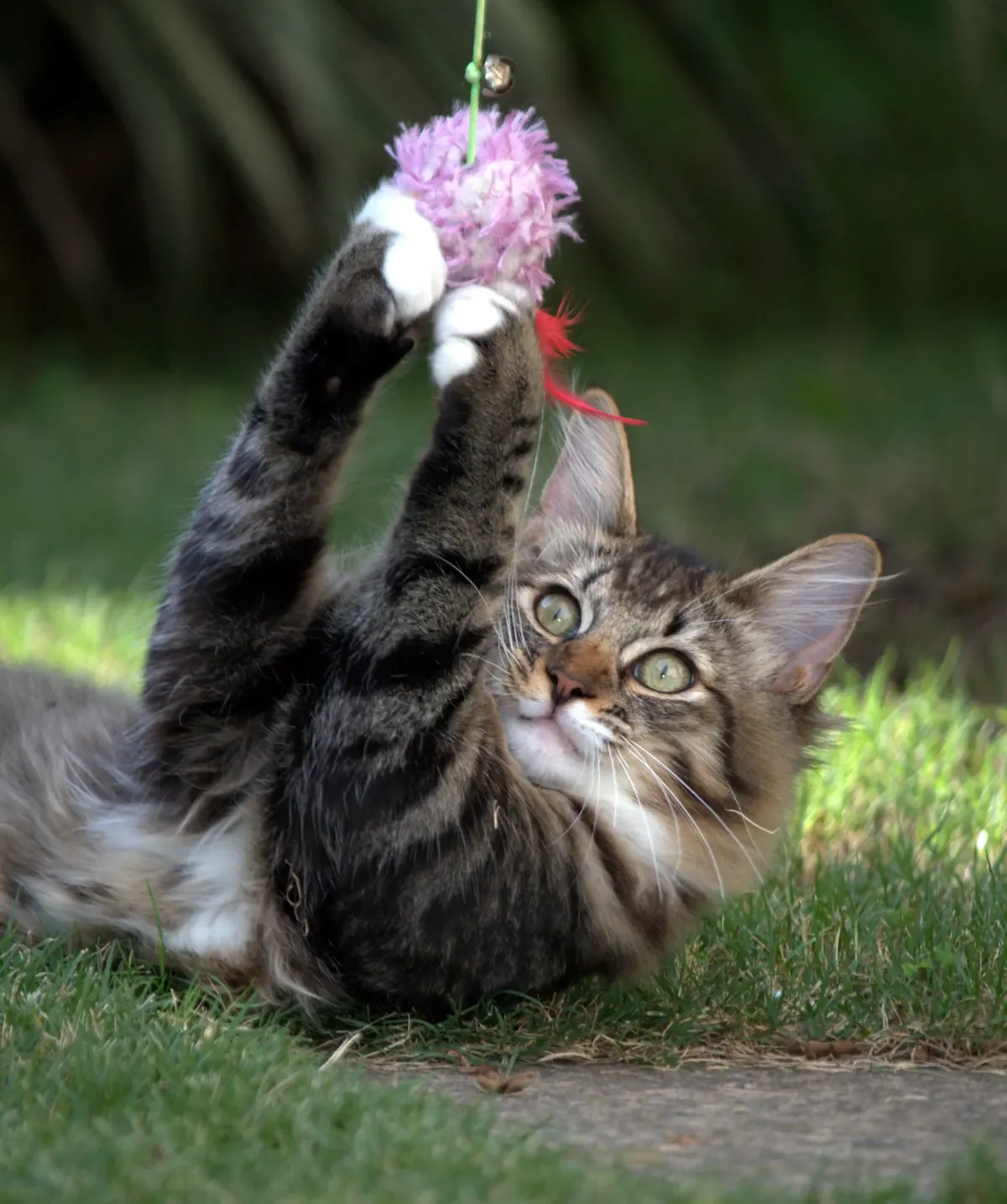
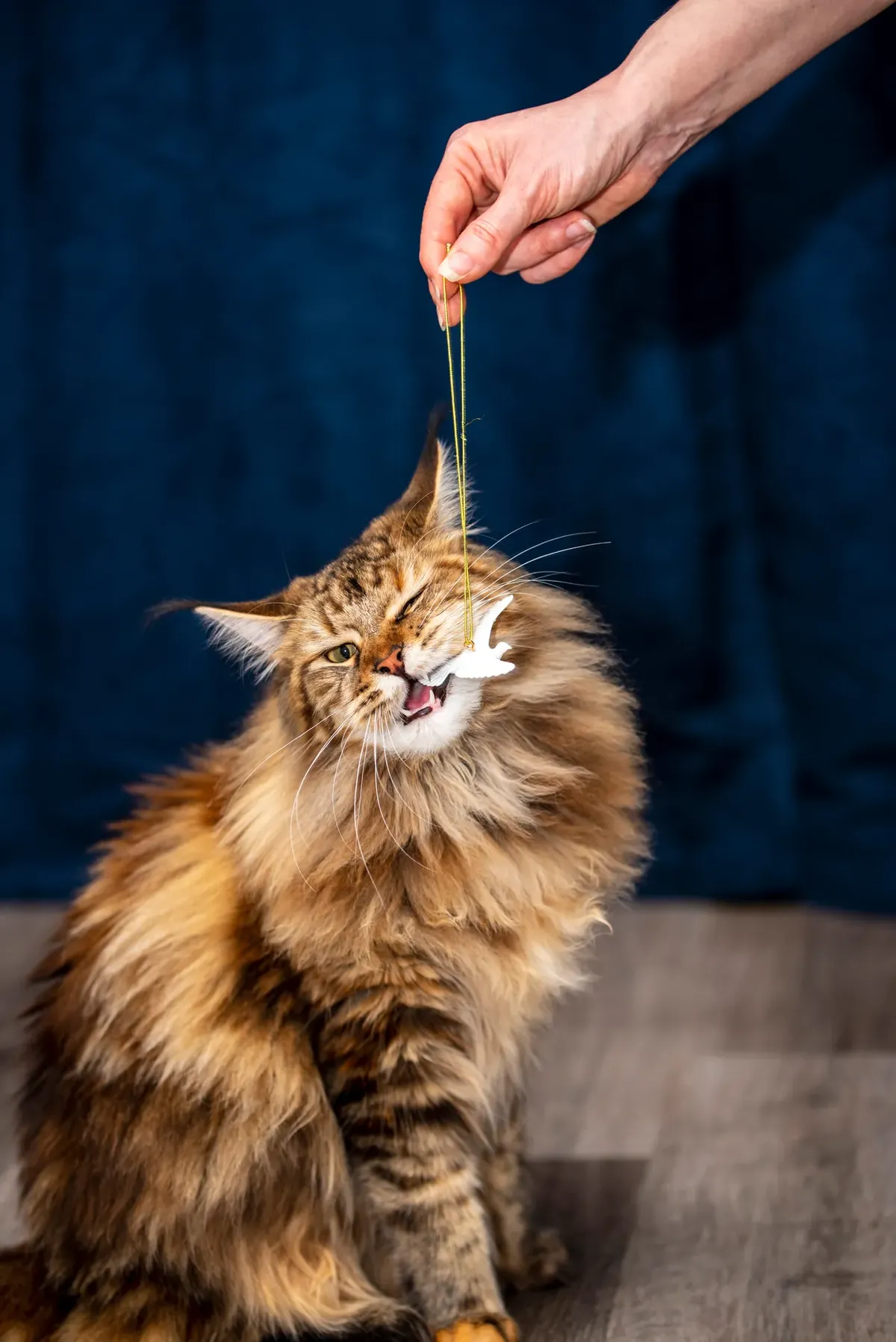
If you buy one thing from this list, make it a good wand toy. Nothing tires out a big, athletic cat faster than ten minutes of leaping after feathers, and interactive play builds trust with a young or shy Coon. The classic is the Go Cat Da Bird — a simple rod with a feather lure that flutters like real prey, with easy-to-find replacement lures for when one gets destroyed.
Two rules for wands in a Maine Coon house. First, buy a sturdy rod — a big cat hitting a flimsy stick at full speed will snap it. Second, put the wand away after every session. PetMD warns that cats left alone with wand strings can chew and swallow them, which can become a medical emergency — and that goes double for a powerful chewer (petmd.com). Stored out of sight, the wand also stays novel for years instead of weeks.
Kicker toys: built for the bunny-kick
The bunny-kick — grabbed with the front paws, kicked with the back legs — is the Maine Coon’s signature move, and it demands a toy with real substance. For a big male, a kicker should be 10 inches or more so he can wrap his whole body around it.
The Yeowww! line is the gold standard for catnip kickers: the Banana, Cigar, and Rainbow are stuffed full with organic catnip (no filler) and sewn from heavy cotton twill that stands up to serious abuse. For Maine Coon proportions, look at their larger fish shapes like the Pollock Fish, which owners of big cats praise as properly kicker-sized, or the Petlinks HappyNip Fun Fins Kicker, which roundups specifically flag for large cats. One breeder I follow recommends Maine-Coon-sized kickers that survived a whole room of her cats and go straight in the washing machine — that washability is gold, because a beloved kicker gets disgusting within a month. Check the seams first: if you can see daylight through the stitching, a Maine Coon will have it open by Thursday.
Puzzle feeders and treat toys: a workout for that big brain
Maine Coons are famously clever — they learn to open doors and figure out faucets, and a bored clever cat invents his own entertainment, usually involving your curtains. Puzzle feeders turn mealtime into a hunting session and slow down fast eaters. Start with a treat-dispensing ball with adjustable openings, then work up to multi-chamber puzzles — and test that the openings actually fit your cat’s paws and tongue first. I once bought a beautiful wooden puzzle my boy solved by simply flipping the whole thing over. Technically he solved it.
Chase-and-bat toys: crinkle balls, springs, and tracks
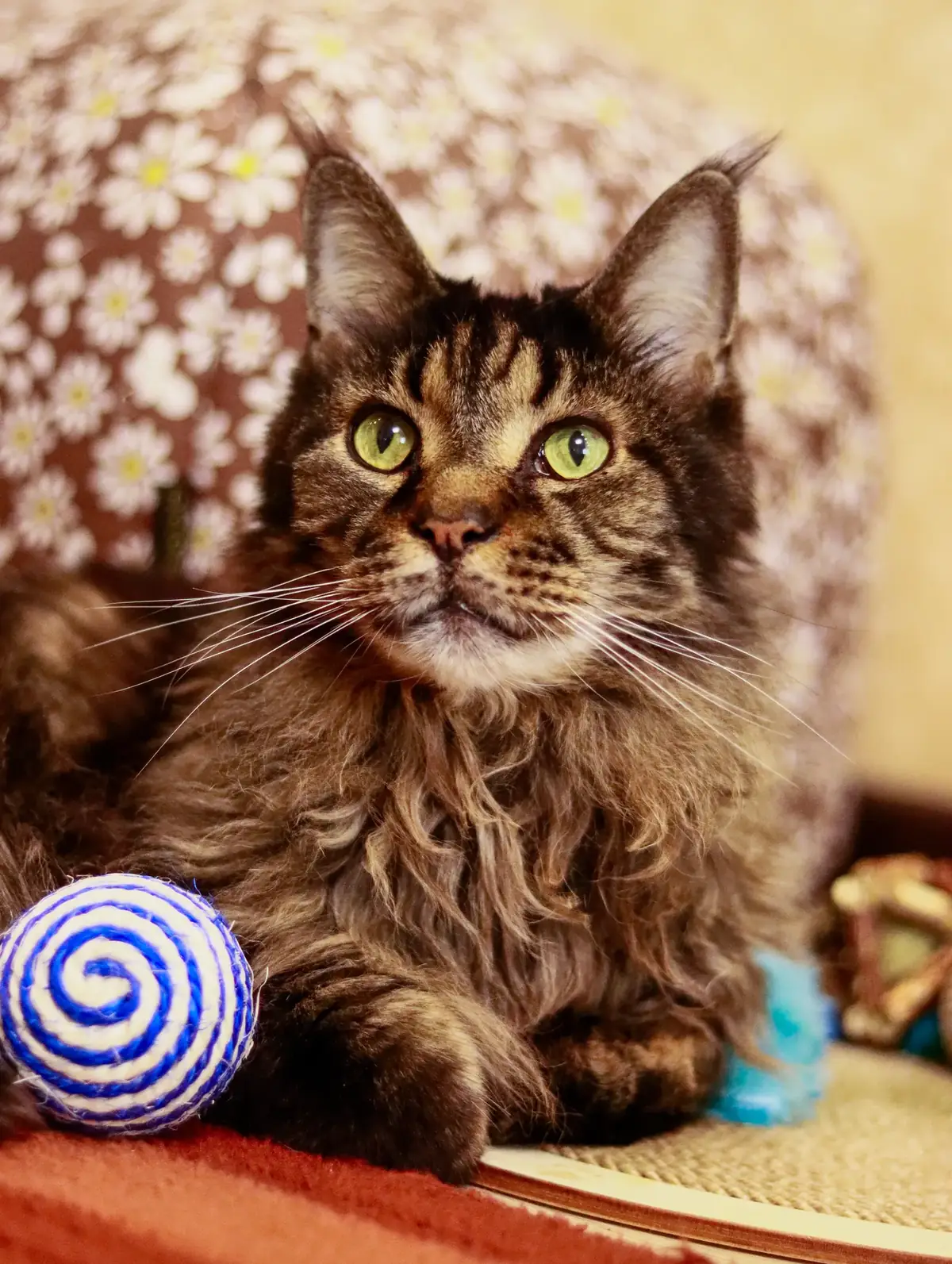
For solo play, you want toys that move unpredictably and make interesting noises. Owners on Reddit and Facebook swear by mylar crinkle balls — the crackly kind — saying their Coons stay obsessed with them for months, though the balls migrate under furniture, so buy in bulk. Plastic springs are another favorite: they bounce erratically, they’re nearly indestructible, and stepping on one barefoot at 2 a.m. is a rite of passage.
For something more substantial, the Petstages Tower of Tracks is a three-tier ball track that holds up well to heavy paws, and the SnuggleKitty Ripple Rug — a configurable fabric play mat with tunnels and peek holes — is one of the few fabric toys explicitly roomy enough for Maine Coon bodies. Go for the sturdy, heavy-based kind: a 20-pound cat leaning into a lightweight track will launch it across the room.
Catnip toys: quality over quantity
Not every Maine Coon responds to catnip (kittens under six months usually don’t), but for those who do, a good catnip toy is pure joy. The difference between a great catnip toy and a dud is the fill: cheap toys are mostly cotton stuffing with a whisper of catnip dust, while the good ones are packed with actual leaf and flower. Store them sealed between sessions to keep the scent potent. If your cat doesn’t care about catnip, try silvervine instead — it works on many catnip-indifferent cats.
Electronic and interactive toys: fun with supervision
Battery-powered toys — flopping fish, rolling balls, motion-activated teasers — can be fantastic for a high-energy Coon. The catch: battery compartments and small moving parts make these supervised-play-only toys in my house. Retire one the moment the casing cracks — a toy that thrills at 7 p.m. should not become a 3 a.m. chewing project.
Tunnels and crinkle caves: the ambush headquarters
Maine Coons are ambush predators, and a tunnel turns a hallway into a hunting ground. The advice from experienced owners is always the same: get the largest size. A tunnel that fits a normal cat is a frustrating squeeze tube for a Maine Coon — full-grown Coons need the biggest size available or they simply won’t go in. Look for sturdy spring wire and a washable center, and check the wire ends periodically since a determined cat can work a tip loose.
Toy Safety: What to Skip for a 20-Pound Athlete
Here is what I actively avoid bringing home:
- Tiny plush mice and mini balls. Anything smaller than a ping-pong ball is a swallowing risk in a Maine Coon’s jaw. Cute is not worth an emergency vet visit.
- Toys with small bells, plastic eyes, or glued-on parts. Cats chew their “prey,” and chewed-off pieces get swallowed. PetMD notes swallowed bells don’t always pass, and metal breaking down in the intestine is genuinely dangerous.
- Loose string, yarn, ribbon, and elastic. This is the big one — wonderful during supervised wand play, genuinely dangerous left out. Ingested string can cause intestinal blockage requiring surgery. Same goes for hair ties and rubber bands, which too many cats steal and swallow.
- Feather toys left unattended. Feathers shred, and shredded bits get eaten. Wand toys live in the closet between sessions, full stop.
- Flimsy electronic toys. If the battery compartment doesn’t screw shut securely or the plastic feels brittle, skip it.
Get in the habit of inspecting toys weekly. The moment you see exposed stuffing, a torn seam, or a loose part, the toy is done — throw it out. With a cat this strong, “I’ll keep an eye on it” lasts about one play session.
Rotation Beats a Bigger Toy Box
Here is the secret the pet stores won’t tell you: you don’t need thirty toys. You need eight to ten good ones and a rotation system. Put half away, swap them every week or two, and every toy feels brand new again. This matters for Maine Coons because they are smart enough to get genuinely bored — and a bored Maine Coon doesn’t just nap. He redesigns your furniture.
Keep wand and electronic toys as special-occasion items that only appear when you play together; kickers, crinkle balls, and springs can live out for solo play. Toys are only one part of enrichment: a sturdy cat tree built for a big cat’s weight gives yours a place to climb between sessions, and a catio adds an outdoor dimension to his day. If boredom is already tipping into shredded-sofa territory, the issue is usually under-stimulation — I break that side down in my guide to Maine Coon behavior problems.
FAQ
Are dog toys safe for Maine Coons?
Often, yes — and owners on social media say they shop the small-dog aisle regularly for this exact reason. A sturdy small-dog plush or rope toy is frequently the right size for a Maine Coon’s paws and jaws. Just apply the same safety rules: no small squeakers that can be chewed out, no plastic eyes, no thin rope strands that unravel.
How many toys does a Maine Coon actually need?
Eight to ten quality toys on rotation beats an overflowing basket of flimsy ones: one wand toy, one or two large kickers, a puzzle feeder, a few crinkle balls or springs, and a tunnel. Swap half out every week or two.
Is catnip safe for Maine Coons?
Yes, catnip is safe — cats can even eat it without harm. Most cats respond to it, though kittens under six months typically show no reaction, so don’t worry if your young Coon ignores it for now. Store catnip toys sealed between uses so they stay potent.
Are laser pointers good toys for Maine Coons?
They are great exercise with one rule: always end by landing the dot on a real toy or treat your cat can “catch.” A hunt that never ends in a catch frustrates any cat. Never shine it near eyes — yours or the cat’s.
My Maine Coon destroys every toy within a day. What am I doing wrong?
Probably nothing — you are buying toys made for smaller, gentler cats. Whenever someone asks me for the best toys for Maine Coons that actually survive, my answer is the same: size up to large-cat or small-dog toys, choose heavy fabrics with tight stitching, and favor washable kickers over delicate plush. And lean into wand play: ten focused minutes with you tires him out more than any solo toy.
The truth is, the best toys for Maine Coons are about matching the toy to the athlete in your living room: big enough to grab, tough enough to survive the bunny-kick, safe enough that you never worry while he has the time of his life. Get the sizing right, rotate the lineup, keep the wand sessions sacred. Your gentle giant will handle the rest.